
Crawford County Wanted List Status
Start with the Crawford County Sheriff's Office, since any public notice would come from that agency. No "Most Wanted" page appears on its site. No "Wanted Persons" list or "Warrant Wednesday" feature either. There is also no posted count, schedule, photo policy, reward promise, or standard listing format. That simply means no public list exists to consult. It does not mean the county lacks outstanding warrants.
A shared social post is a poor stand-in. So is a stray search result. Warrants get recalled, served, or changed, and old copies can linger online long after. A later court order may never show up in a repost at all. The court file and direct court instructions always carry more weight. Any photo remains with its original source, and no wanted or booking images appear here.
Crawford County Listing Fields
No current list is published, so Crawford County has no official fields to describe. If the sheriff adds one, read only what each entry actually states. Check its update date too. A future notice might include some of the fields above, but every item needs verification rather than assumption.
| Possible field | How to read it |
|---|---|
| Name and photograph | Identification supplied by the agency, not proof of guilt or current custody. |
| Warrant basis | The alleged offense, missed appearance, or other stated reason for the order. |
| Issuing court | The court that can explain the file and lawful response. |
| Bond or status | A condition that can change and must be confirmed. |
| Last update | The date that helps expose an old or stale notice. |
Keep the records straight. A wanted listing describes someone being sought, not a county jail record. Once a person is arrested and booked, custody becomes a separate matter. The county's booking-record and custody routes explain how to contact the jail or request a record at that stage.
Using Crawford County Wanted Information
Always begin with the source and its date. A current sheriff or court page beats any aggregator, screenshot, or copied post. The lack of an official photo list changes the process. It never justifies trusting an unofficial database.
- Open the official sheriff and court pages. Confirm the source is Crawford County, Michigan.
- Check the posting date, issuing agency, and court reference. Do not infer a current warrant from an undated image.
- If you recognize someone in a genuine notice, do not make contact. Give the sheriff the link and facts you personally know.
- If the possible warrant concerns you, contact the appropriate court or an attorney and arrange a lawful response.
- After an arrest, check custody and court records separately. A wanted notice does not show the case result.
The official Crawford criminal-process page makes a good visual starting point. It walks through how magistrates issue warrants, run arraignments, set bond, and may order a person held in jail.
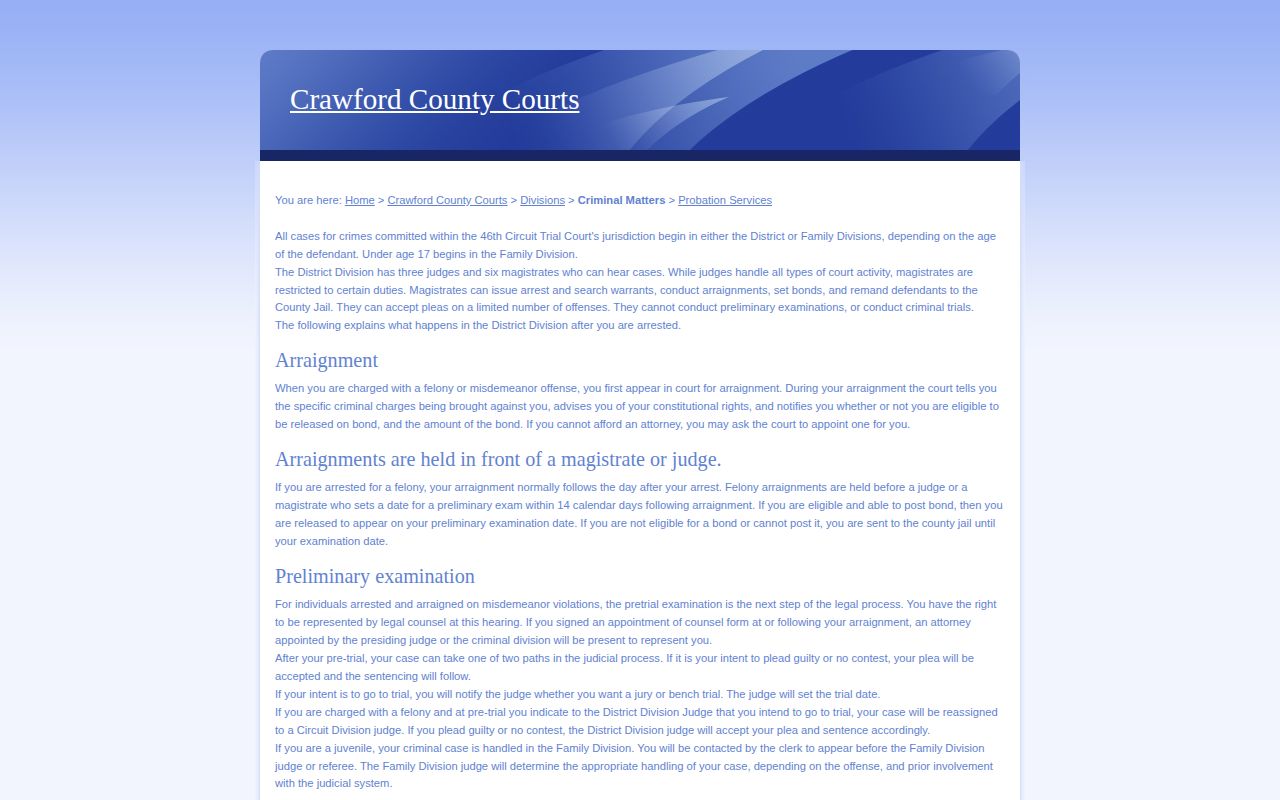
That page links a warrant to its proper stage in court, though it is not a live list of who is wanted today.
Check Crawford County Warrants
Crawford County has no official public warrant-search portal. The county's warrant explanation defines the term plainly: a judge-issued order that lets police make an arrest. In practice, the route runs through the 87-C District Court or 46th Circuit Court clerk at the county courthouse. The MiCOURT Case Search works only as a preliminary check. It is informational, leaves out nonpublic material, and does not track live warrants.
- Search MiCOURT for an existing Crawford County case using accurate details.
- Contact the court shown on the case, or the Crawford clerk when no reliable result appears.
- Ask what official steps apply and whether an older or certified file must be requested.
- If the warrant may concern you, speak with counsel or the court. Follow formal appearance instructions.
- Do not treat a “no result” screen as proof that no warrant exists.
The county's own traffic guidance shows how this works. Skip a court date and a warrant can follow. Anyone with one is told to appear in court. That is why a courthouse check beats any commercial search result. The Crawford traffic warrant instructions spell out the local appearance route.
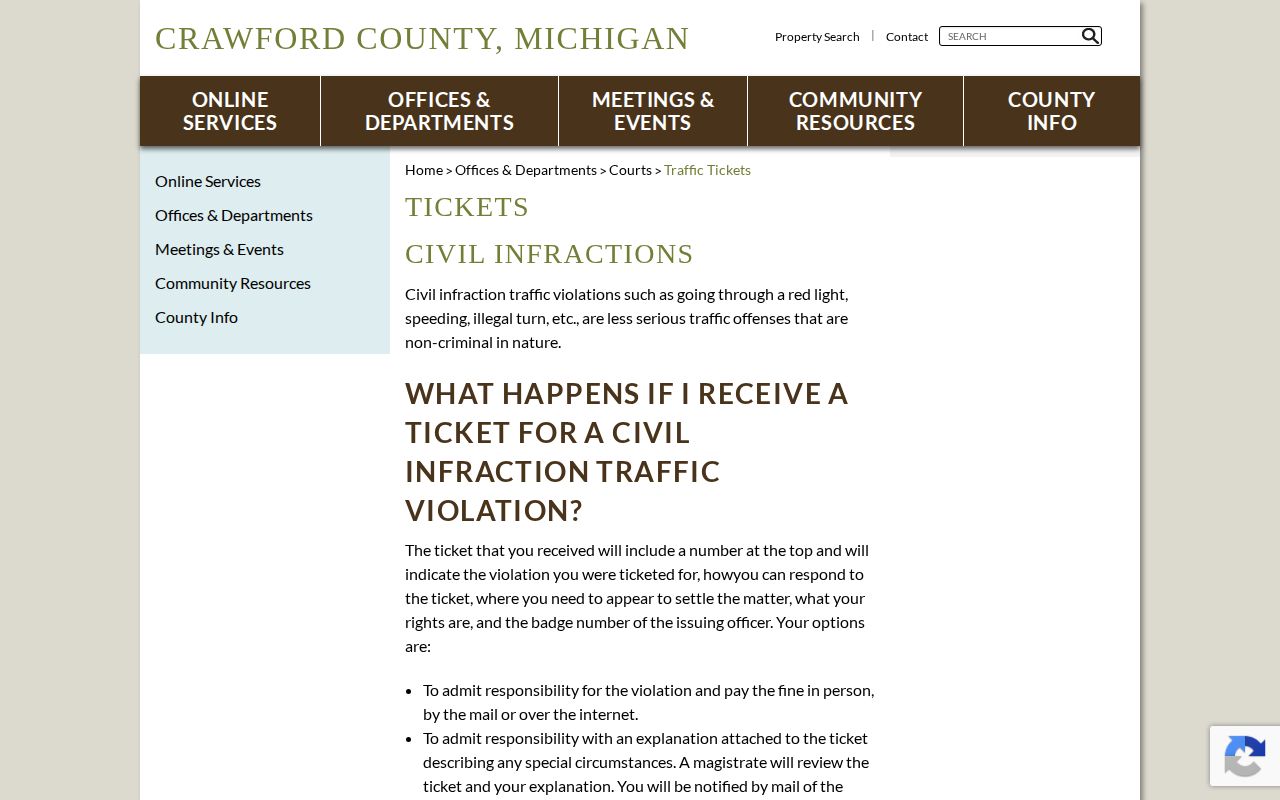
Keep in mind that this source deals with traffic matters, so it is not a universal warrant database. It does confirm the county's court-first path for resolving them.
Crawford County Warrant Types
Labels matter here. These orders arise at different points in a case. The court, not a search snippet, can tell you what order is active in a file. These plain-language distinctions frame the question without predicting anyone's situation.
| Type | General meaning | Safe contact |
|---|---|---|
| Arrest warrant | A judge authorizes an arrest based on the matter presented. | Issuing court or attorney |
| Bench warrant | A court may issue it after a missed appearance or failure to follow an order. | Court clerk or attorney |
| Search warrant | A judge authorizes a defined search. It is not a wanted list. | Court record or counsel |
A warrant is not a charge, a booking, or a conviction. Each is distinct. Booking records show jail intake. An arraignment is the first hearing, where charges and release terms get addressed. A disposition is the final result: dismissal, plea, acquittal, or conviction. Charges can shift or vanish along the way. The disposition is what settles it.
Crawford County Wanted Tips
The sheriff does publish a crime-tip route. But no separate Crime Stoppers program, anonymity guarantee, or reward policy could be verified. Do not promise anonymity or money the agency has not stated. Keep the report short and factual. Then let trained staff take over.
Crawford County Sheriff’s Office Crime Tips200 W. Michigan Ave.
Grayling, MI 49738
Tip line: (989) 344-3228
Email: tips@crawfordsheriff.org
Helpful details include the notice you saw, when and where you observed something, and a safe callback method. Never trespass or tail a vehicle. Don't dig for private details or tie up emergency lines with routine records questions. Call 911 only for an immediate threat or a true emergency.
For general routing, use the sheriff's administrative line at (989) 348-4616 ext. 214. Dispatch is (989) 348-6341. Neither line is promised as a public warrant-confirmation service.
Crawford County Alerts Differ
Don't expect one Crawford County app to do everything. There is no verified sheriff booking feed or wanted-person list here. Smart911 handles emergency notices by phone call, text, or email, nothing more. MI-VINE is the tool for custody tracking. It sends alerts when a participating inmate is released, transferred, or escapes, and it also covers some court-status changes. Neither service posts mugshots or warrant lists, so treat them as alert systems rather than record searches.
Smart911 is for emergencies. MI-VINE tracks a custody or court status you already know about. Tips about a wanted person go to the sheriff. Court files get confirmed by the court itself. And be careful with look-alike apps: a service from another Crawford County, or another state, is not a Michigan source.
Crawford County Court Follow-Up
A warrant check answers a narrow question. It tells you whether a court order exists, not what happens next. Under Crawford County's official process, arraignment follows the arrest and booking. At that hearing the court reads the charge, takes up the question of counsel, and sets terms of release. For felonies, the county says arraignment usually happens the next day. A preliminary examination generally follows within fourteen days. Those clock rules cover court steps only. They say nothing about when a warrant notice, jail entry, or booking photo appears online.
A magistrate sets bond or orders the person held in the county jail. Remand means held. Bond means released on court conditions while the case moves forward. Later docket entries might show an amended charge, a dismissal, a plea, a trial result, or a sentence. MiCOURT gives a preliminary case view, though the state cautions that some material stays nonpublic and older files may require calling the court. When the online record looks thin, ask the clerk for the register of actions, a certified order, or the original file.
Keep the custody stages straight. A warrant means someone may be sought, not that an arrest happened. A wanted notice names a person law enforcement wants, though Crawford County publishes no verified public list of them right now. A booking shows jail intake only. Release ends that booking, even if the case keeps going. Only a final disposition settles the outcome. Keeping these stages apart stops an old wanted mention from being read as current custody.
The county court page lists contacts for the 87-C District Court and the 46th Circuit Court. Both sit at the Grayling courthouse. Match your request to the court handling the case and follow the clerk's instructions. Anyone addressing a warrant should go through the court or a lawyer and arrange a lawful appearance. No online search replaces that direct, safe path.
Public Record Search
Sponsored Results